


With gas prices, inflation, grocery costs, and more continuing to climb across Canada and Waterloo Region, new numbers are showing that the region’s livable wage is continuing to climb, while outpacing the province’s minimum wage by over $5 per hour.
The details come from the Ontario Living Wage Network, which details the average living wage across the province and various counties across Ontario, showing how they line up and change compared with the current minimum wage.
As of now, Ontario’s minimum wage is set at $17.95 per hour, which grew from $17.60 back on Oct. 1.
RELATED:
Region’s unemployment rate drops, still sits well above national average: StatCan
‘Kitchener is ready to contribute’: Mayor Vrbanovic reacts to new 2026 Federal Budget
“Ontario workers are the engine of this province,” said David Piccini, Minister of Labour, Immigration, Training and Skills Development at the time of the wage increase in October.
“By raising the minimum wage to one of the highest in Canada, our government is putting more money in the pockets of Ontario workers, supporting families through economic uncertainty and giving businesses the stability and predictability they need to plan and grow.”
In comparison, the Ontario Living Wage Network currently has the living wage for Dufferin-Guelph-Wellington-Waterloo at $23.40, that’s a different ov $5.45 compared to the current minimum wage.
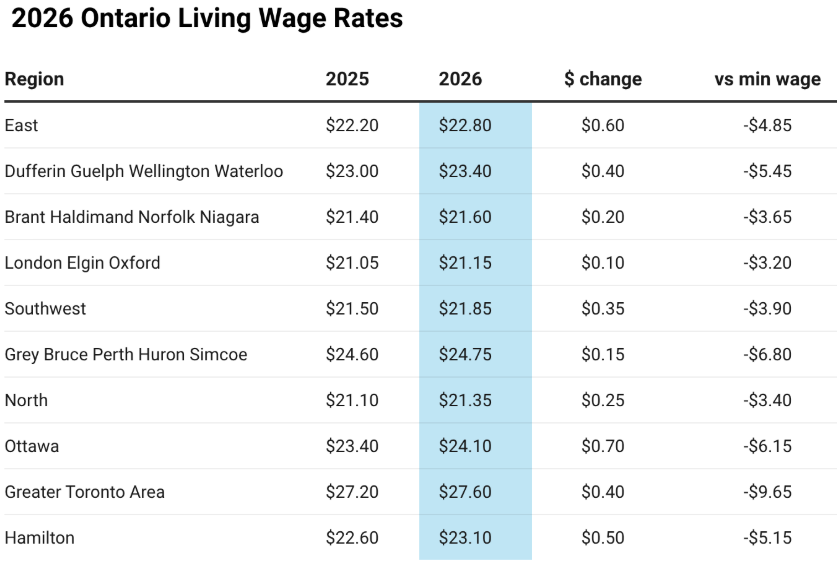
“Despite the annual October 1 increase to Ontario’s minimum wage of $17.95 per hour, the gap between minimum wage and living wage remains significant,” said the Ontario Living Wage Network.
“Even in the region with the lowest living wage rate, a person working full-time at minimum wage would still fall short of what they need to cover basic expenses.”
While a minimum wage is defined by the Government of Canada as “a basic labour standard that sets the lowest wage rate that an employer can pay employees,” a living wage is an estimate of what a worker would actually require per hour to cover basic living expenses, including food, water, transportation, childcare, and more.
The network specified that “There is still no region in Ontario where minimum wage is enough to afford the cost of living.”
“More and more people are working for low wages. They are facing impossible choices: buy food or heat the house, feed the children or pay the rent,” the Ontario Living Wage Network stated.
“The result can be spiralling debt, constant anxiety, and long-term health problems. In many cases it means that the adults in a family are working long hours, often at two or three jobs, just to pay for basic necessities.”
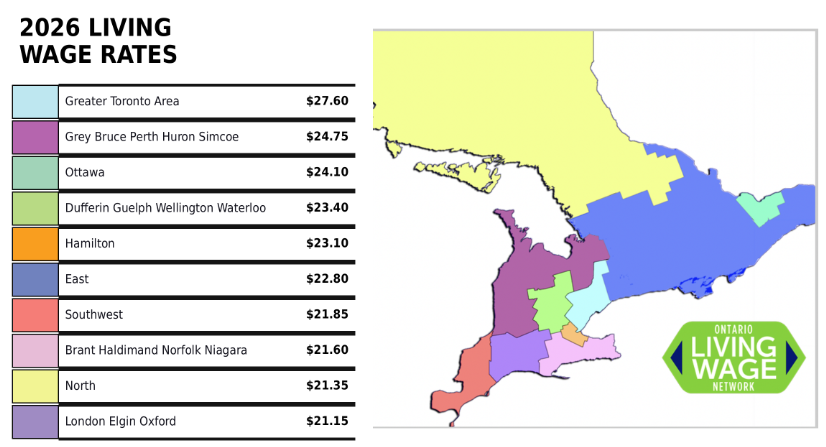
While the disparity between the livable and minimum wages in the province continues, the provincial network did specify that the gap between the two has gotten smaller than in years past.
According to figures released by the network, the average living wage across the province is increasing at a rate of 1.6 per cent, compared with 5.3 per cent in 2025.
“While the increases vary across the province, all 10 regions saw their living wage rates rise.”
In Waterloo Region, which is included alongside Guelph, Wellington, and Dufferin, the living wage was recorded as being the fourth highest among the 10 listed areas, with the Greater Toronto Area (GTA) sitting the highest at $27.60 per hour and London-Elgin-Oxford sitting the lowest at $21.15.
The full report included in the lastest release can be found on the Ontario Living Wage website.





Comments