


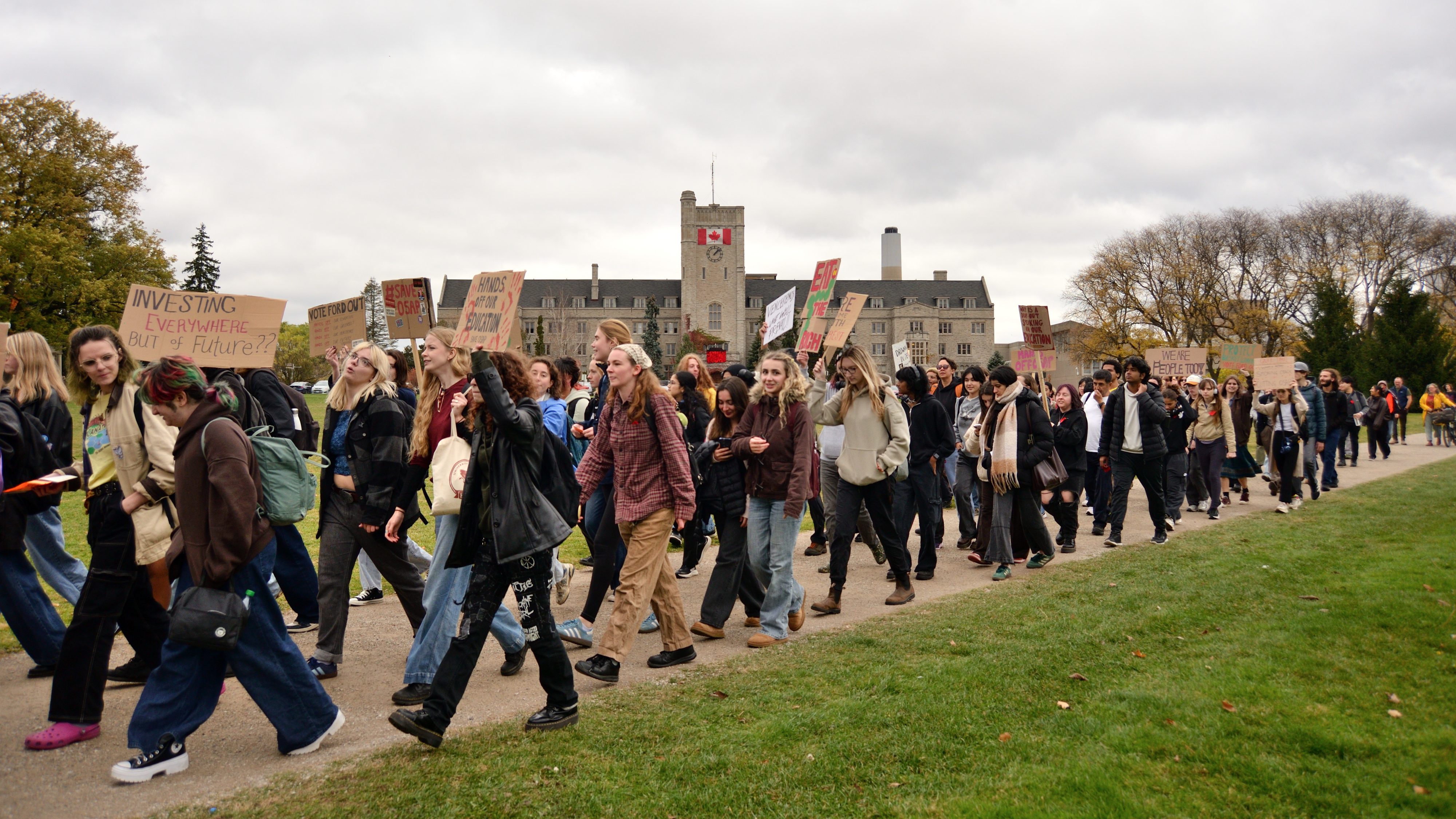
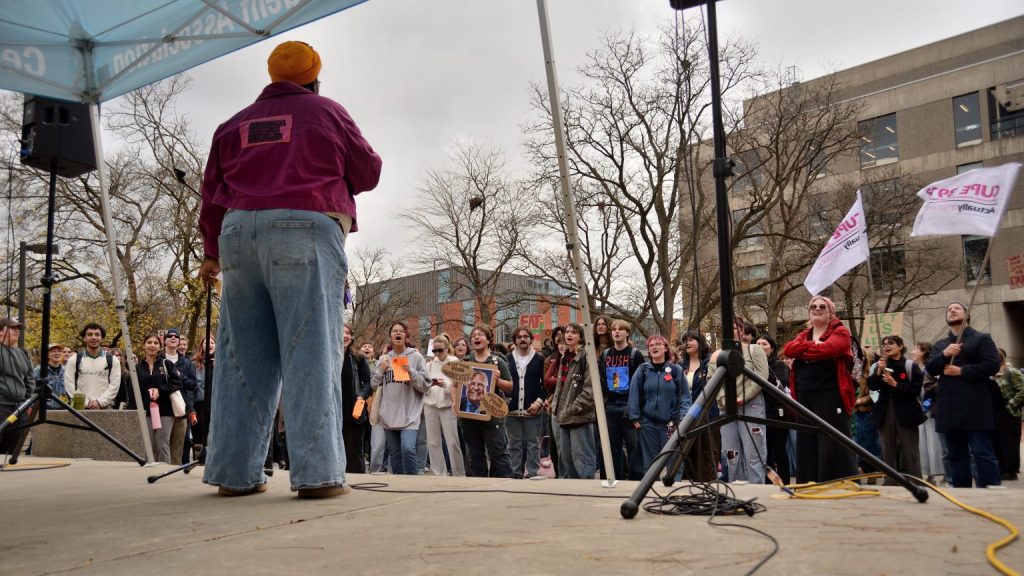
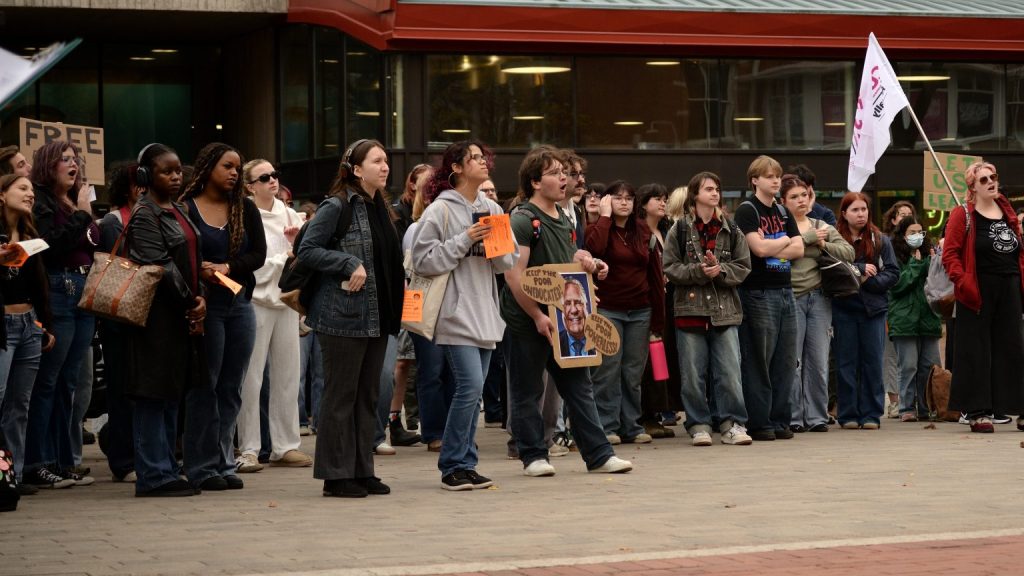
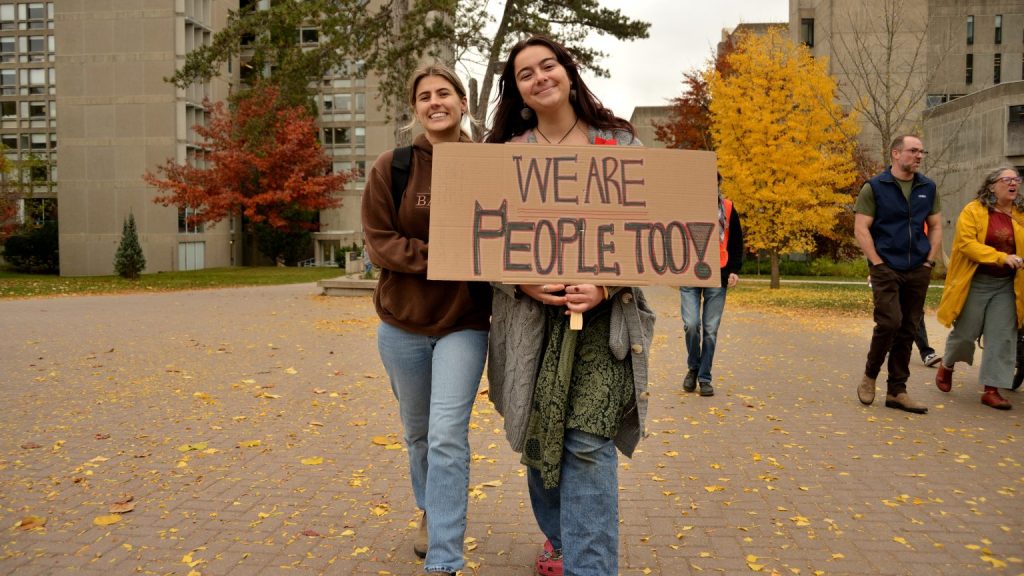
A large crowd of University of Guelph students gathered in Branion Plaza at the heart of UofG to walk out in protest of the changes made to the funding structure of the Ontario Student Assistance Program (OSAP).
On Feb. 12, this year, the provincial government announced a “stronger, more sustainable OSAP system.”
A press release issued that day said that, “To strengthen the long-term sustainability of OSAP and bring it in line with other provinces, Ontario students will be eligible to receive a maximum of 25 per cent of their OSAP funding as grants and a minimum of 75 per cent of their funding as loans.”
Previously, OSAP grants could cover up to 85 per cent of the students’ funding.
In the same press release, the provincial government announced they have forgone the tuition freeze mandated seven years ago; “Ontario will allow publicly assisted colleges and universities to raise tuition by up to 2 per cent per year for three years, then up to 2 per cent or the three-year average rate of inflation, whichever is less, in the years following,” the press release said.
“I just wanted to cry really because I remember a lot of my professors are saying they’re in their forties and fifties; some of my younger professors, they’re still paying off their loans and it just, it’s so devastating because I want to make real change,” said UofG student Julia Sharp.
“I’m applying to grad school right now. I want to study the environment to help, but it’s hard when I can’t afford to do so. And it’s just really, it just makes me really sad because we’re in Canada, like we should be able to have free education and it’s just really ridiculous.”
RELATED:
UofG students to walkout over ‘unavoidable payments’ amidst province’s OSAP changes
U-W receives $80M provincial investment to add over 2,500 in-demand seats
Sharp said she feels like the provincial government and the decisions of Premier Doug Ford are constricting her future; she already is in about $30,000 of student loan debt and expects to pile on another $30,000 once enrolled in postgraduate education.
She also said students have been experiencing financial hardship for decades and have since seen little-to-no change to support their future; Sharp recalls stories from her mother, who studied at Western to become a personal support worker, and was sometimes forced to choose between buying hygiene products or dinner due to financial constraints.
“At this point, I’m applying to jobs left, right, and center, and we’re trying. It’s not like we’re just lazy,” Sharp stated.
“I’ve applied to probably 50 jobs in person and through all the different job postings, and you just don’t hear back because there’s so many of us who are trying to work, but there’s just not enough opportunities because you need an education, but you can’t get an education if you can’t afford it.”
The walkout was promoted by the Central Student Association (CSA), a student union representing undergrad students enrolled at UofG, and they had also erected the “Wall of Debt,” which was open for students to write down how much student debt they are in.
CSA president and fourth-year UofG student Emilie Dudgeon said it’s bittersweet to see students reveal their levels of debt due to post-secondary expenditures.
Clip of CSA President and fourth-year UofG student, Emilie Dudgeon
Dudgeon has also heard multiple personal accounts of post-secondary students needing to make tough decisions because they simply don’t have enough money or time.
“Hearing that students can’t afford rent, hearing that students are wondering whether or not they can come back next semester because the loans are too high, hearing students having to work multiple jobs just to pay off and keep up with their education costs and having that impact their education directly by, you know, falling asleep in morning classes or having to skip classes for work. We’re seeing a very real impact on students,” said Dudgeon.
She said these changes to funding also affect future enrollment.
One of the event’s guest speakers was Kayla Weiller of the Canadian Federation of Students-Ontario, a province-wide student union representing about 300,000 students.
“When students come to an action like today, it’s really clear that they’re not the only ones affected and that many of their classmates’ peers are also affected by it too,” said Kayla Weiller with the Canadian Federation of Students-Ontario..
“I’m not a student anymore, but when I was a student, I took on thousands of dollars of student debt from a small town in Ontario and from Walkerton. I used to think that I was the only one, but I got involved with my student union on campus. I got involved with the Federation, and I realized I’m not the only one. We’re all fighting for the same goal, the same access to education, and so this is exciting to see we’re all united under the same banner.”

Weiller has been with the federation for about nine years and has noticed a pattern of the Ford government steadily whittling down support for Ontario education.
“They say it’s not a cut, they say it’s a reallocation, but in reality, less grants for students is a cut because it makes education more inaccessible for them to attend,” said Weiller.
The Nov. 5 walkout was coordinated; students also walked out on campuses in Ottawa, Toronto and Windsor.
Weiller said it was amazing to see students come out and fight for better support systems.





Comments